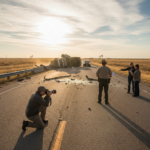
The moments immediately following a collision with a large commercial truck are often a blur of confusion, pain, and fear. One minute you are driving down a Texas highway, and the next, your life has been turned upside down by a massive 18-wheeler. If you have been hurt in an accident, your first thoughts are likely about your health, your family, and how you’re going to pay the bills piling up on your kitchen counter.
The legal system is probably the last thing you want to navigate alone, especially when you are up against a trucking company with deep pockets and a team of aggressive lawyers. Their goal is simple: to minimize their payout by denying fault. Your goal is to recover and secure the financial support you need to move forward.
To bridge that gap, we have to prove liability. We must demonstrate, with clear and convincing evidence, that the truck driver or the trucking company was negligent. This process can feel overwhelming, but you do not have to face it by yourself. At McKay Law, we pride ourselves on a track record of proven success, and we understand exactly what it takes to build a watertight case against negligent defendants.
The Importance of Establishing Liability in Personal Injury Cases
In the legal world, “liability” is just another word for responsibility. Before you can receive a single dollar for your medical bills, lost wages, or pain and suffering, we must prove that the other party is legally responsible for your injuries.
In Texas, this is particularly critical because the state follows a rule known as modified comparative negligence. This rule states that you can only recover damages if you are 50% or less at fault for the accident. If a court finds that you were 51% responsible—perhaps they argue you changed lanes unsafely or were speeding—you could be barred from receiving any compensation at all.
Trucking insurance companies know this rule well. They will often send investigators to the scene within hours to look for any evidence they can use to shift the blame onto you. Establishing clear liability isn’t just about proving they did something wrong; it is about protecting your right to recovery against these tactics. By building a strong foundation of fault against the defendant, we ensure that your voice is heard and your financial future is protected.
Understanding the Burden of Proof and Legal Standards
When we take your case, we take on the “burden of proof.” In a civil personal injury case, this standard is called a preponderance of the evidence. Unlike criminal cases where guilt must be proved “beyond a reasonable doubt,” in a civil case, we simply need to show that it is “more likely than not” that the defendant’s negligence caused the crash. Think of the scales of justice; we only need to tip them slightly in your favor (51%).
To do this, we generally look to prove the four pillars of negligence:
- Duty of Care: We must show that the truck driver owed you a duty to drive safely. Every driver has this duty, but commercial drivers are held to even higher standards due to federal regulations.
- Breach of Duty: We must prove the driver failed in that duty. This could be speeding, driving while fatigued, or failing to inspect their vehicle.
- Causation: We must link that specific breach of duty directly to the accident.
- Damages: Finally, we must prove that you suffered actual harm—physical, emotional, or financial—as a result.
For more on how negligence is defined legally, the Legal Information Institute offers a comprehensive overview.
Critical Evidence Collection: Building Your Case
Winning a truck accident case rarely comes down to one person’s word against another’s. It comes down to hard evidence. Because 18-wheelers are heavily regulated, they leave a trail of data that passenger cars do not. Our team moves quickly to preserve this evidence before it is lost or destroyed.
The Police Report
The official crash report filed by law enforcement is the starting point. It contains the responding officer’s initial assessment of fault, diagrams of the scene, and witness information. While the report itself isn’t always the final word, it provides an objective narrative that is difficult for insurance companies to ignore.
The “Black Box” (ECM)
Most modern commercial trucks are equipped with an Electronic Control Module (ECM), often called a “black box.” This device records data about the truck’s operation in the seconds before a crash, including speed, brake application, and engine RPM. This data is often undeniable proof of what the truck was doing at the moment of impact.
Electronic Logging Devices (ELDs)
Federal law limits how many hours a truck driver can operate without a break to prevent fatigue. Drivers track this using ELDs. We pull these logs to see if the driver was over their hours-of-service limit, which is a common cause of accidents. The Federal Motor Carrier Safety Administration (FMCSA) outlines these strict regulations.
Maintenance and Hiring Records
Sometimes the fault lies with the trucking company, not just the driver. We request maintenance logs to see if the truck had bad brakes or bald tires that the company ignored. We also look at hiring files—did the company hire a driver with a history of DUIs or reckless driving? If so, the company itself may be liable for negligent entrustment.
Witness Statements
Third-party witnesses are invaluable. They have no stake in the outcome and can provide an unbiased account of what happened. We work to interview witnesses while their memories are fresh to corroborate your version of events.
The Role of Expert Witnesses in Reconstructing Accidents
Sometimes, the evidence is messy. The trucking company might claim you swerved into them, while you know they drifted into your lane. When the story is disputed, we call in the experts.
Accident Reconstructionists are professionals who use physics, mathematics, and engineering to recreate the crash. They analyze skid marks, vehicle crush profiles, and the resting positions of the vehicles to determine speed and trajectory. They can scientifically prove that the truck driver’s version of events is physically impossible.
We may also utilize Trucking Industry Safety Experts. These are often former safety directors or fleet managers who can testify about the standard of care expected in the industry. They can explain to a jury exactly how the defendant violated safety protocols that responsible trucking companies follow every day.
Finally, Medical Experts help us prove the extent of your injuries. They connect the violence of the crash to your specific medical condition, countering any arguments that your pain is from a pre-existing condition or an unrelated incident.
Proving Causation: Linking Negligence Directly to Your Injuries
It is not enough to prove that the truck driver was texting or that the truck had bad brakes. We must draw a straight line from that negligence to your specific injuries. This is called causation.
For example, if we find that the truck had a broken tail light, but the accident happened in broad daylight when the truck rear-ended you, the defense will argue that the broken light didn’t cause the accident.
However, if we find that the driver was fatigued and had violated hours-of-service regulations, and the accident was a rear-end collision caused by a delayed reaction time, the link is clear. Fatigue causes slow reaction times; slow reaction times cause rear-end collisions.
We use your medical records and biomechanical experts to show that the forces involved in the specific type of collision you experienced are consistent with your injuries. If you suffered a herniated disc, we show how the force of the truck hitting your vehicle caused that specific trauma.
Common Defense Tactics and How to Counter Them
Trucking companies and their insurers are in the business of saving money, not paying it out. You can expect them to use several standard tactics to devalue your claim.
The “Comparative Fault” Trap
They will try to pin the blame on you. They might argue you were speeding, distracted, or merged improperly.
- The Counter: We use the objective data from the accident reconstruction and the truck’s black box to prove you were driving safely. We also use witness statements to back up your actions.
The “Pre-Existing Condition” Argument
If you have ever had back pain or a previous injury, they will argue that the truck accident didn’t hurt you—you were already hurt.
- The Counter: We use detailed medical comparisons. We have your doctors compare your physical state before the accident with your condition afterward, using MRIs and X-rays to show new, distinct damage caused by the crash.
The “Sudden Emergency” Defense
The driver might claim they had a heart attack or faced a sudden, unavoidable road hazard that forced them to hit you.
- The Counter: We investigate thoroughly. Was the “hazard” actually something a calm, attentive driver could have avoided? Was the “medical emergency” foreseeable due to a known health condition the driver shouldn’t have been driving with?
Spoliation of Evidence
Sometimes, trucking companies “lose” critical data or repair the truck before it can be inspected.
- The Counter: We send a Spoliation Letter immediately upon taking your case. This is a legal notice demanding they preserve all evidence. If they destroy it after receiving this letter, the court can sanction them and instruct the jury to assume the missing evidence would have hurt their case.
How Professional Legal Counsel Strengthens Your Claim
Navigating a claim against a major trucking carrier is not a DIY project. These cases involve complex federal regulations, massive amounts of electronic data, and aggressive corporate defense teams.
At McKay Law, we handle the heavy lifting so you can focus on healing. Here is how we change the dynamic of your case:
- Investigation: We have the resources to launch an immediate investigation, securing video footage and black box data before it disappears.
- Negotiation: We know the true value of your claim. We calculate not just your current medical bills, but your future care needs, lost earning capacity, and the emotional toll of the accident. We don’t let insurance companies lowball you.
- Litigation: While most personal injury cases are settled out of court, some do go to trial. If the insurance company refuses to offer a fair settlement, you need someone who is ready and willing to take your case before a judge and jury.
If you have been hurt in an accident involving a commercial truck, you need to know your rights. We fight for your rights to ensure you are not bullied into a settlement that doesn’t cover your needs.
Don’t let the complexity of the legal system keep you from the justice you deserve. Contact McKay Law today for a free consultation. We operate on a contingency fee basis, meaning clients pay nothing upfront and no legal fees unless the case is won. Let us help you get your life back on track.