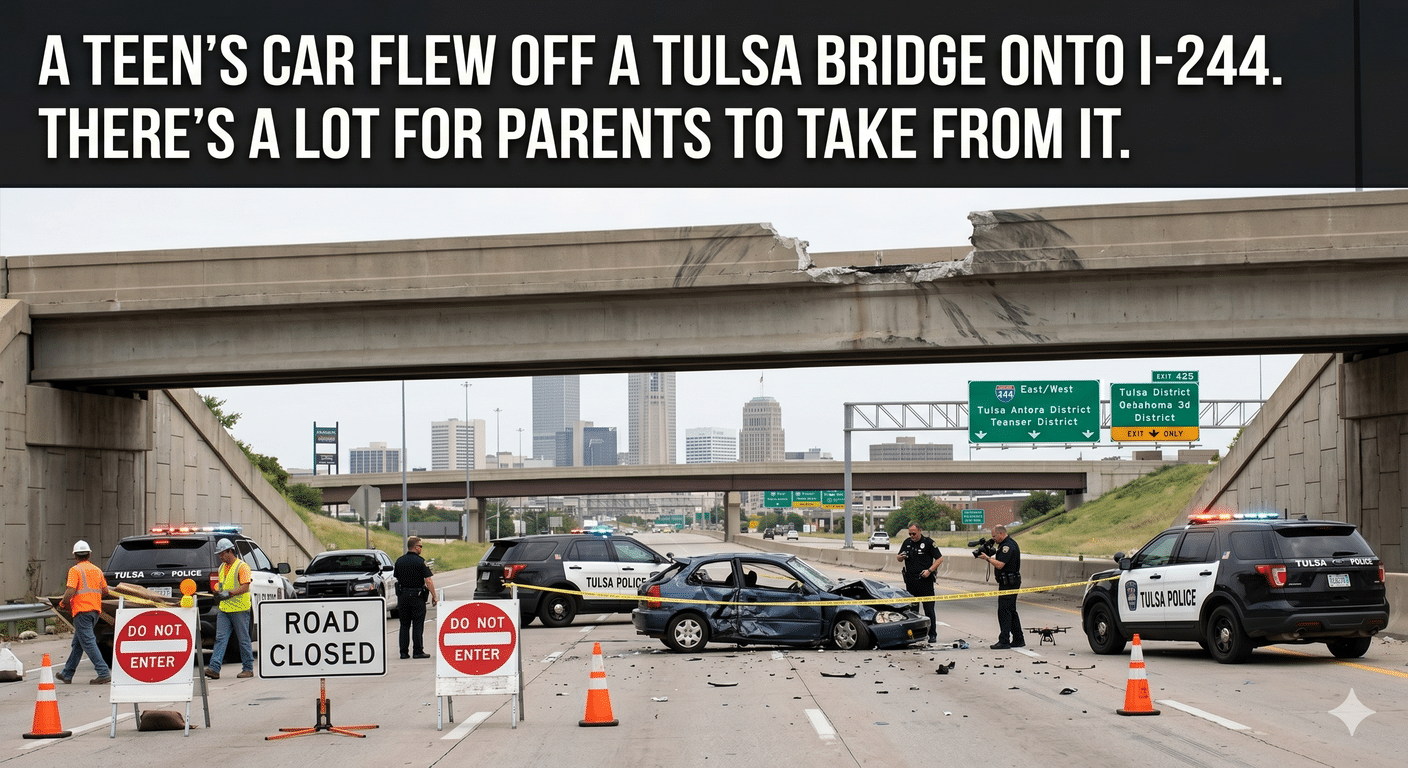
If you live in Tulsa, you probably saw the photos before you read the story. A car, upside down on the eastbound lanes of I-244, the morning sky still gray behind it. The kind of image that makes you stop scrolling and squint at your phone, trying to figure out how that’s even possible.
Here’s what happened, according to Tulsa Police: around dawn on Saturday, April 11, a 17-year-old was driving west on West 41st Street with an 18-year-old friend in the passenger seat and a 1-year-old in the back. He blew through the stop sign at 25th West Avenue and Southwest Boulevard, missed the slight curve in the road, hit the curb, and the car went airborne. It cleared a drainage ditch, plowed through a fence, and dropped about fifteen feet onto the interstate, landing on its roof. The baby — who wasn’t in a car seat — was hurt but is expected to recover. Police haven’t ruled out charges. (KTUL has the full report.)
It’s a wild story. It’s also, unfortunately, a story that pulls together almost every theme we deal with at McKay Law on a regular basis: a young driver, an unrestrained child, a routine intersection that turned dangerous in a split second, and injuries that will follow this family long after the news cycle moves on.
So instead of just rubbernecking, let’s talk about what’s actually worth taking from it.
Tulsa’s roads aren’t unusually dangerous. Tulsa’s new drivers are.
This is the part that surprises a lot of parents. For experienced drivers, Oklahoma roads are about as risky as anywhere else in the country. But teenagers are a different conversation. The CDC’s research is consistent: drivers aged 16 to 19 are involved in fatal crashes at roughly three times the rate of drivers 20 and up, per mile driven. The risk climbs higher on weekends, after dark, and — this is the one a lot of families miss — when there are other teenagers in the car.
Look at the I-244 crash through that lens and it’s almost a checklist. New driver. Teen passenger. Early morning. A maneuver — running a stop sign and then trying to ride out a curve — that takes the kind of split-second judgment most 17-year-olds genuinely haven’t built yet, no matter how confident they feel behind the wheel. Throw a baby in the back without a car seat, and what should have been a citation became a fall off a bridge.
If you’re the parent of a Tulsa teen who’s driving — or about to be — this is your nudge to actually have the conversation again. Cap the passenger count. Phone goes in the glove box, not the cup holder. Anyone they’re driving around, especially small children, gets buckled the right way every single time. The Oklahoma Highway Safety Office and NHTSA both have free parent-teen driving agreements. They feel a little corny when you sit down to do them. They also work.
The car seat issue is bigger than people realize — legally and otherwise
Oklahoma law is pretty specific here. Children under 2 ride rear-facing. Kids under 8 (who are also under 4’9″) need an approved restraint or booster. Most Tulsa parents know this in the abstract. The part that catches people off guard is what happens legally when a child gets hurt and wasn’t properly restrained.
Two questions tend to come up.
The first is who caused the crash. In a typical wreck, the at-fault driver — the one who ran the sign, sped, drove distracted, whatever it was — is on the hook for the injuries that followed, including injuries to passengers who weren’t theirs. That includes kids. A child who’s hurt has every right to pursue a claim, and Oklahoma’s two-year filing deadline is actually paused for minors until they turn 18 in most situations.
The second is whether anyone else shares blame. Oklahoma uses a modified comparative fault rule — get blamed for 51% or more of a crash and you walk away with nothing; less than that, and your recovery gets reduced by your share. Insurance companies know this, and a missing car seat is one of the things they reach for when they’re trying to chip away at a claim. It’s an argument, not a verdict. But it’s the kind of argument you really don’t want to be having on your own with an adjuster on the phone.
The injuries that don’t show up at the scene
There’s a particular thing that happens after a serious crash, and especially after a rollover or a fall: people walk away, feel rattled but okay, decline the ambulance, go home, and wake up the next morning unable to turn their head. Or fine for a week, then suddenly dizzy at work. Or — and this is the one that scares me most as a parent — a kid who seems shaken but unhurt and then starts having nightmares, withdrawing, refusing to get back in a car.
The injuries to keep in mind:
- Whiplash and soft-tissue neck injuries that bloom 24 to 72 hours later
- Concussions and other traumatic brain injuries, which can present as just feeling “off”
- Internal bleeding, which is exactly as bad as it sounds and not always painful at first
- Spinal injuries that announce themselves first as numbness or weakness in a hand or leg
- PTSD, anxiety, and sleep problems — extremely common after frightening wrecks, and especially in kids and teens
Get checked out the day of the crash. Saint Francis and Hillcrest both run Level II trauma centers here in Tulsa. Beyond the medical reasons, having a same-day record connecting your symptoms to the crash matters enormously if you end up filing a claim later — and the emotional fallout is its own legitimate piece of an Oklahoma personal injury case, not a footnote.
What to actually do in the 48 hours after a Tulsa wreck
Driver, passenger, parent of an injured kid — the playbook is mostly the same.
See a doctor. Even if you’re sure you’re fine, especially if you’re sure you’re fine.
Pull the police report. Tulsa PD lets you request traffic collision reports through tulsapolice.org. For crashes out on the highways or outside city limits, that’s Oklahoma Highway Patrol’s territory.
Take pictures of everything you can — the cars, the road, the weather, your injuries as they develop, anything in the other car that might suggest distraction (a phone face-up on the seat, an open food container, the GPS still routing).
Don’t give the other driver’s insurance company a recorded statement. I cannot say this strongly enough. The adjuster will be friendly. They will sound concerned. They are, in the most literal sense, gathering evidence to pay you less. Tell them you’ll follow up and call a lawyer first.
And speaking of —
When it’s actually worth calling a lawyer
Honest answer: not every wreck. A bumper tap in a parking lot doesn’t need an attorney. But if any of the following are in play, talk to one — and at McKay Law, that conversation is free and there’s no pressure attached:
A child or passenger got hurt. Someone needed an ambulance or ER. The other driver was a teen, was speeding, blew a sign or light, or seemed distracted or impaired. The wreck involved a rideshare driver, a delivery driver, or someone driving a company vehicle. The insurance company is dragging its feet, lowballing you, or starting to point fingers your way. Or someone — usually the adjuster — is asking pointed questions about car seats, seat belts, or what you “could have done differently.”
The aftermath of a real crash is brutal in a way that’s hard to describe until you’re in it. The bills come fast. The phone won’t stop ringing. You’re trying to heal, and you’re being asked to remember exact details of the worst minute of your year. You don’t have to do the legal piece by yourself.
Talk to a Tulsa Car Accident Attorney at McKay Law
Our Tulsa office is at 5401 S. Harvard Ave., Suite 103. Lindsey McKay and our team have helped Oklahoma families pull through after car wrecks, truck crashes, and the kinds of catastrophic injuries that change a life in a single afternoon. If you or someone you love was hurt — in this crash, in another recent one, or in something that happened weeks ago and you’re just now realizing how badly it shook you — call (918) 236-0000. Or read more on our Oklahoma Car Accident Lawyer page and reach out when you’re ready.
Had a bad day? Call McKay.