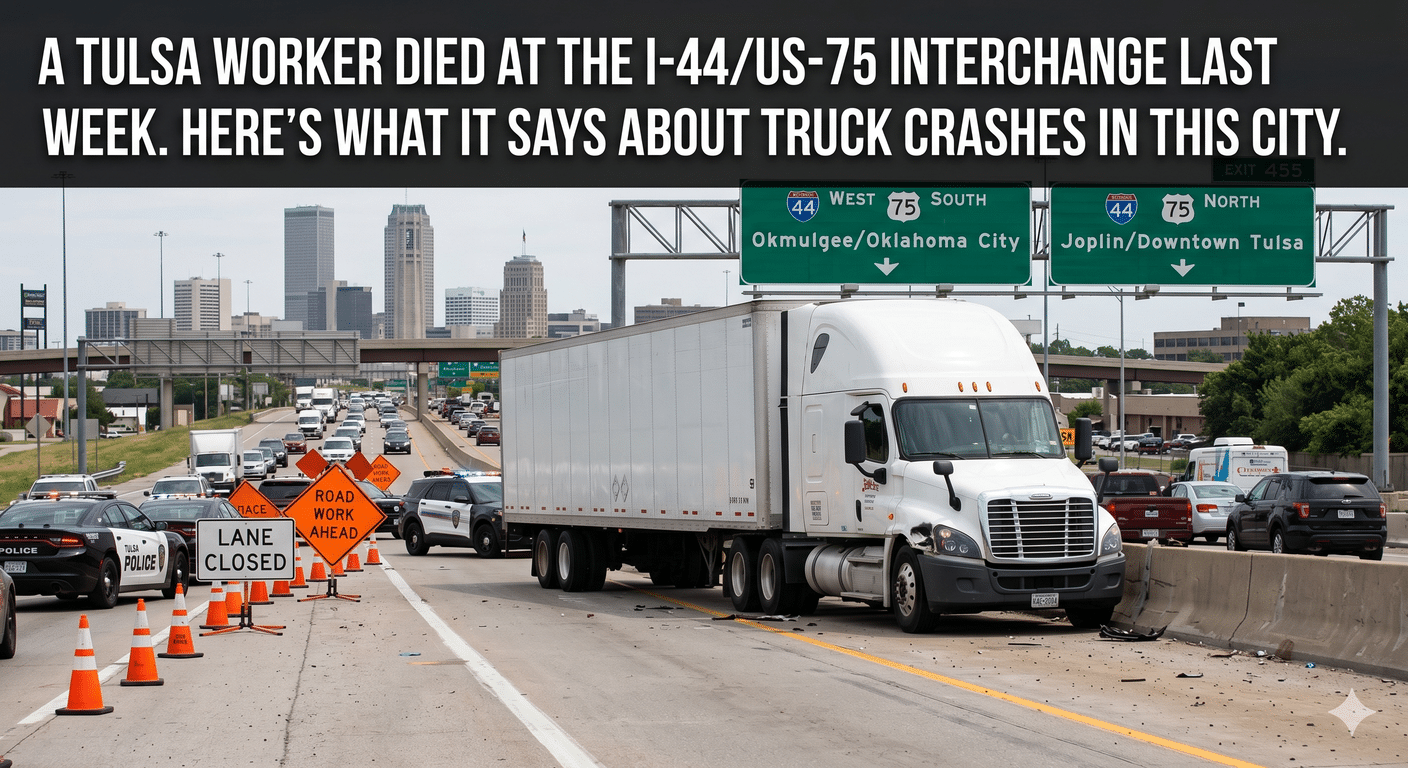
Javier Gardea was 22 years old. He worked construction. On the afternoon of April 23, he was on the job at the I-44 and US-75 interchange — the rebuild that’s been chewing up south Tulsa for years now — when a dump truck backed up and ran him over. He died at the scene. Some of the people on the crew that day were his own family.
He was about to become a father. His first child was due in a matter of weeks.
Tulsa Police released his name on April 29. East Central High School, where he’d played soccer, retired his jersey that same night. ODOT put out a statement. The investigation is ongoing, but at this point everyone involved seems to agree it was a tragic accident — no foul play, no malice, just a backing truck and a young man who happened to be standing in the wrong place. Whether “tragic accident” is the end of the legal story is a different question entirely, and that’s the one I want to spend a few minutes on here.
If you drive I-44, the BA, US-75, US-169, or the Creek Turnpike, this story should land hard. Tulsa is in the middle of a once-in-a-generation infrastructure rebuild, and the trucks that are doing that work are the same trucks that are killing people. Workers, mostly. But also drivers who never even got out of their cars.
The Construction-Zone Problem Nobody’s Really Talking About
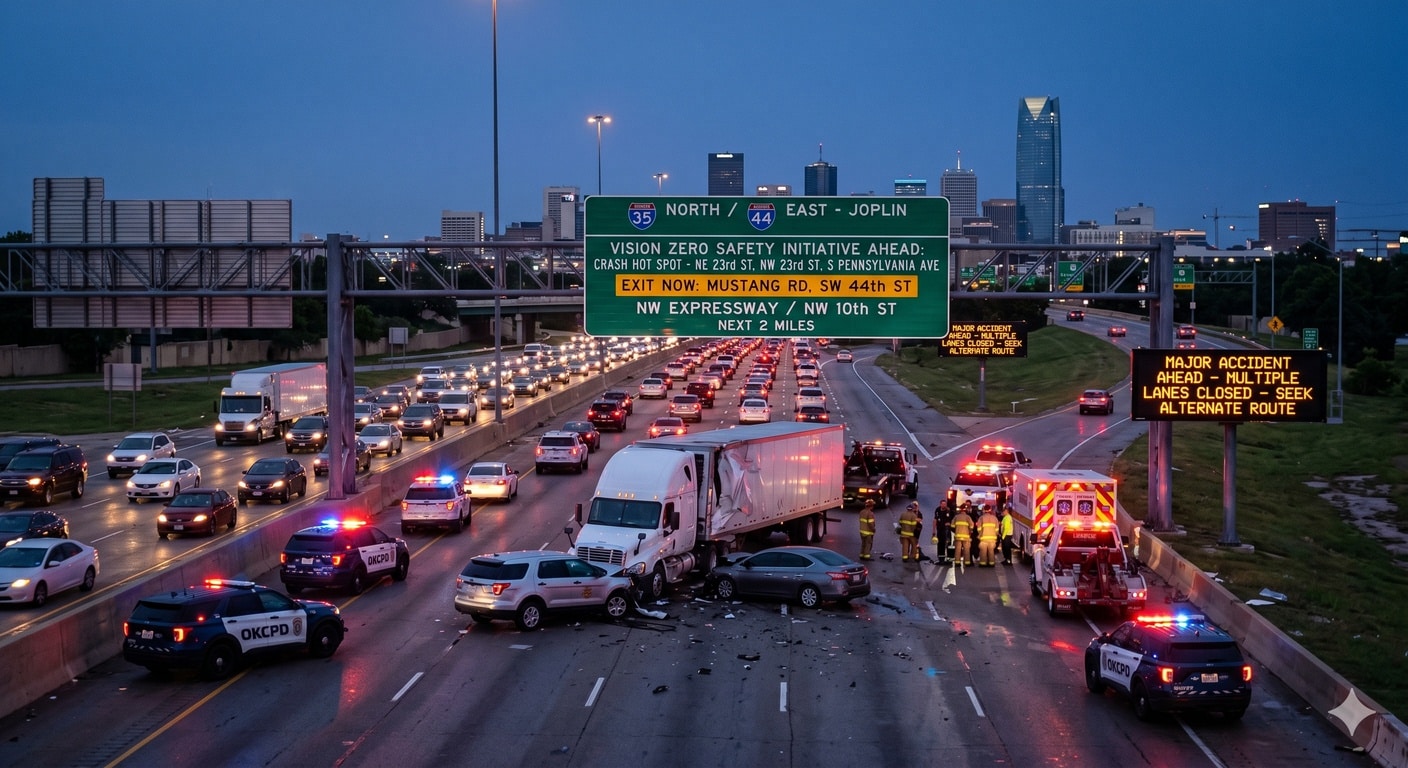
Look at any major highway map of the metro right now. Nearly every corridor has at least one active work zone. The I-44/US-75 interchange project alone has been running for what feels like forever, and it’s not close to done. ODOT keeps the cones moving and the lane shifts coming, contractors keep hauling material in and out, and somewhere in there real people — both the crew on foot and the commuters in traffic — keep getting hurt.
There are two patterns that account for most of it.
The first is backing heavy equipment. Dump trucks have an enormous blind spot directly behind the cab. We’re talking 30 feet or more in some cases. Federal regs require backup alarms, but anyone who’s spent five minutes near a working construction site knows those alarms get drowned out the second another truck fires up nearby. OSHA has been calling backing accidents one of the leading causes of construction worker fatalities for over a decade. Spotters are supposed to be assigned. Often they aren’t. Or they are, and the assignment exists on paper but not in practice.
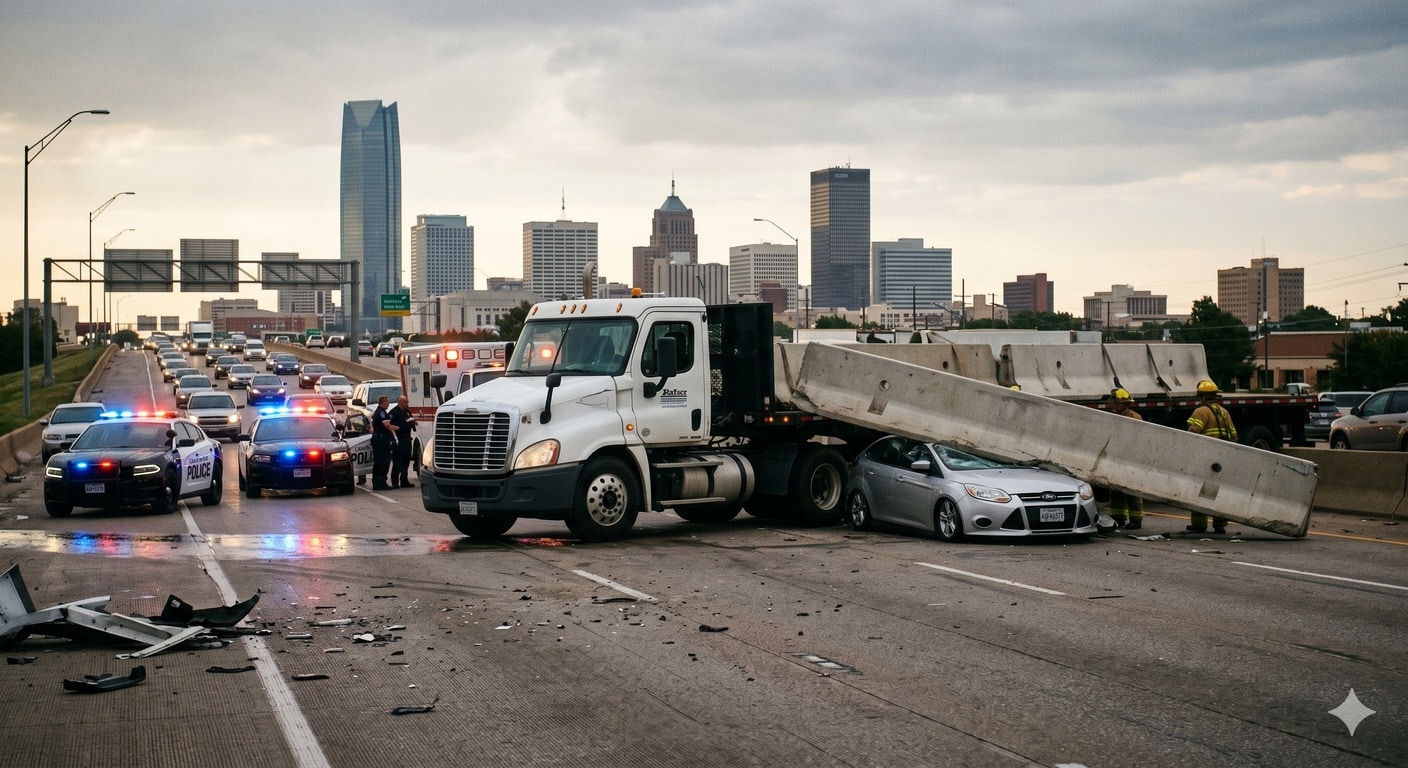
The second pattern is what happens to the rest of us, the ones in passenger cars. Work zones funnel four lanes of traffic into two, between concrete barriers, at highway speed. One distracted driver is all it takes. Phone, GPS, kid in the back seat — eyes off the cones for two seconds and you’re into the back of a stopped construction truck. That’s almost exactly what happened on I-44 near 33rd West Avenue back in February: a driver hit a construction truck stopped on the shoulder. One person killed, one injured.
Oklahoma got named one of the twelve deadliest states in the country for truck crashes in a national report that came out late last year. Between 2017 and 2023, this state had 875 fatal truck crashes. Do the math — that’s a fatality every three days. For seven years straight.
Who’s Actually on the Hook When a Truck Causes a Crash in Tulsa
This trips up almost everyone. The natural assumption is that you sue the driver. That’s it, that’s the case.
It’s almost never that simple.
A single commercial truck crash can have four, five, sometimes six different parties with potential liability, and finding all of them is the difference between a settlement that pays a hospital bill and a settlement that actually protects a family long-term. In a work zone fatality like the one at I-44/US-75, the people you’d be looking at include the driver, sure, but also the trucking company or general contractor that put him behind the wheel — Oklahoma’s respondeat superior doctrine pulls them in for negligent operation, but it can also pull them in for negligent training, negligent supervision, or negligent hiring if there are red flags in the driver’s record. Then you’ve got subcontractors who handled traffic control and spotter assignments. The truck’s owner or leasing company if maintenance was lousy. Equipment manufacturers if a backup sensor or camera failed. And in multi-vehicle work zone crashes, any third-party motorist whose distraction or speed contributed.
Oklahoma is a modified comparative negligence state. If you’re 51% or more at fault, you collect zero. The trucking company’s insurer knows that, and shifting blame onto the victim is a standard play. It’s not paranoid to expect it; it’s actually the default. Which is why getting a lawyer involved early — before recorded statements, before signed paperwork, before the trucking company’s investigators have had three weeks to build their version of events — matters more than people realize.
Evidence Walks Out the Door Fast
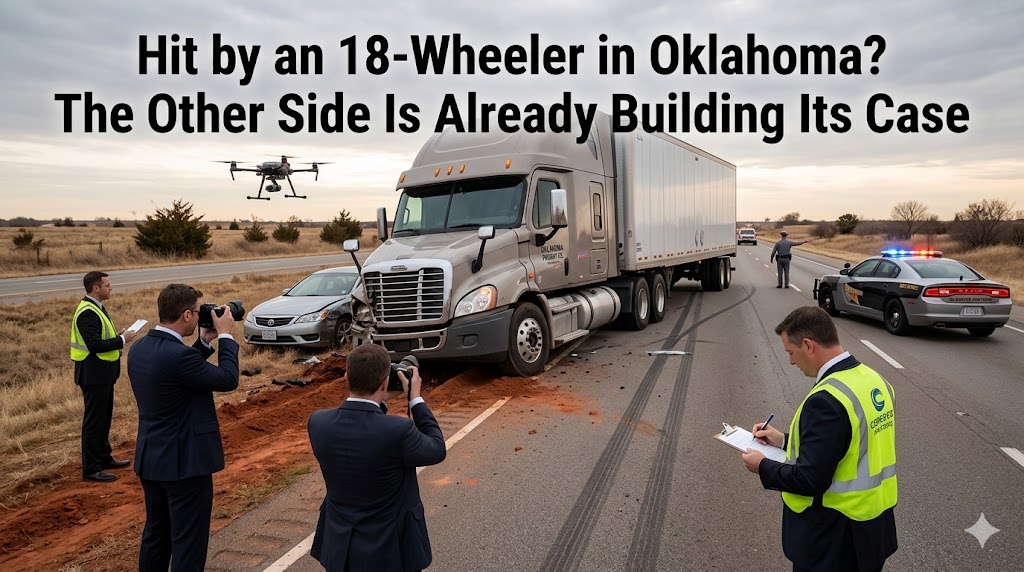
Trucking companies have rapid response teams. They’ve had them for years. The minute one of their trucks is in a fatal crash, an investigator and usually a defense attorney are on the way to the scene, and they aren’t there to figure out what really happened — they’re there to start building the defense.
Meanwhile the family of the victim is in a hospital, or planning a funeral, or just trying to remember how to breathe. By the time anyone thinks about hiring a lawyer, a lot of evidence is already gone or starting to disappear.
ELD data — that’s the Electronic Logging Device, which tracks hours of service, speed, hard braking, idle time. Onboard cameras and dashcams, which a lot of fleets auto-overwrite anywhere from 7 to 30 days out. Maintenance and inspection records. The driver’s qualification file. Drug and alcohol testing results — federal law actually requires post-crash drug testing of any commercial driver involved in a fatal accident under 49 CFR § 382.303, and if it didn’t happen, that’s not just a missed step, that’s evidence in itself. Dispatch records. The driver’s cell phone activity. The site safety plan and the traffic control plan for that work zone. The spotter assignment and crew roster for that shift.
What you need is a spoliation letter — a formal legal demand that the trucking company preserve everything — and you need it out the door fast. Not in three weeks. Days.
What These Cases Actually Pay
Truck accident damages in Oklahoma aren’t capped the way some other personal injury claims are, and they tend to fall into three categories.
Economic damages cover the hard numbers — past and future medical bills, lost wages, lost earning capacity, funeral costs, property damage, and for catastrophic injury survivors, things like home modifications and ongoing care.
Non-economic damages are pain and suffering, loss of enjoyment of life, mental anguish, and in wrongful death cases the loss of companionship for the surviving spouse, children, and parents.
Then there are punitive damages, which are available when a defendant’s conduct goes beyond ordinary negligence into “reckless disregard.” That sounds like a high bar, and it is — but it shows up in trucking cases more often than people think. A pattern of hours-of-service violations. Falsified logs. Maintenance defects that were flagged and ignored. A failure to drug-test after prior incidents. Any of that can open the door to punitives, and punitives are how you actually change a trucking company’s behavior going forward.
One thing worth knowing: federal regs require commercial carriers to carry significantly more liability insurance than passenger drivers — minimums of $750,000 for general freight, up to $5 million for hazardous cargo. That coverage exists for a reason. The insurer’s whole job is to pay you as little of it as they can get away with.
If You’re the One Reading This After a Crash
Doesn’t really matter what kind of truck it was. Could’ve been an 18-wheeler. A dump truck. A delivery van. A company-owned vehicle being driven on the job. Even a rideshare situation that turned into a serious wreck. The first 72 hours play out about the same.
Get medical care, even if you feel okay. Adrenaline lies. CT scans don’t.
Call the police and ask for a written report. Inside Tulsa city limits that’s TPD; out on I-44, I-244, US-75, or US-169 it’s the Oklahoma Highway Patrol.
Take pictures. The vehicles, the scene, skid marks, lane configurations, any visible markings on the truck — DOT number, company name, trailer number. Get names and phone numbers from witnesses, and on a job site that includes other workers.
Don’t give a recorded statement to the trucking company’s insurance adjuster. They will call. They will sound friendly. Don’t do it.
Don’t sign anything. Don’t cash a “quick settlement” check.
And before the trucking company’s people start working on you, talk to a Tulsa truck accident lawyer.
The statute of limitations on most personal injury claims in Oklahoma is two years from the date of the injury. Wrongful death falls under that same window, generally, though depending on the circumstances the clock can start running from a different event. Two years sounds like a lot. It isn’t. Waiting is the single most expensive decision a family in this situation can make.
Helpful Resources
- Oklahoma Highway Patrol — Crash Reports & Information
- Oklahoma Department of Transportation — Work Zone Information
- FMCSA Crash Statistics Dashboard — pull Oklahoma-specific numbers
- FMCSA Large Truck and Bus Crash Facts — annual federal report
- Workzone Safety Information Clearinghouse — FHWA work zone fatality data
- NHTSA Fatality Analysis Reporting System
- OSHA Highway Work Zone Safety
Talk to McKay Law
The Gardea family is going through something nobody should have to go through, and there’s no rewinding what happened on April 23. But if you or someone you love has been in a truck crash anywhere in the Tulsa metro — I-44, US-75, the BA, the Creek Turnpike, side streets, anywhere — we can help. The team at McKay Law handles these cases from the first phone call through trial if it gets there, and we advance every cost along the way. No fee unless we win.
Tulsa office: 5401 S. Harvard Ave., Suite 103. (918) 236-0000.
Had a bad day? Call McKay.