It happened in seconds.
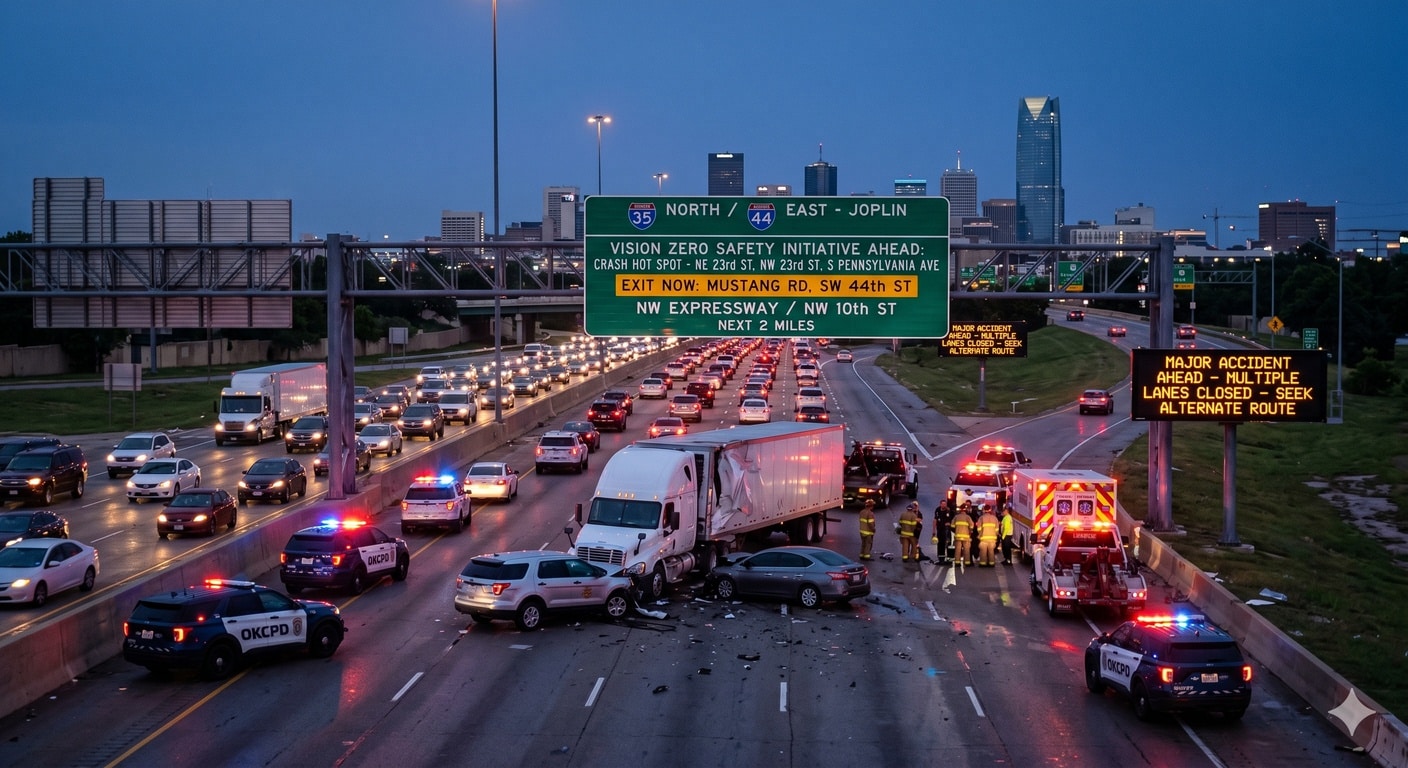
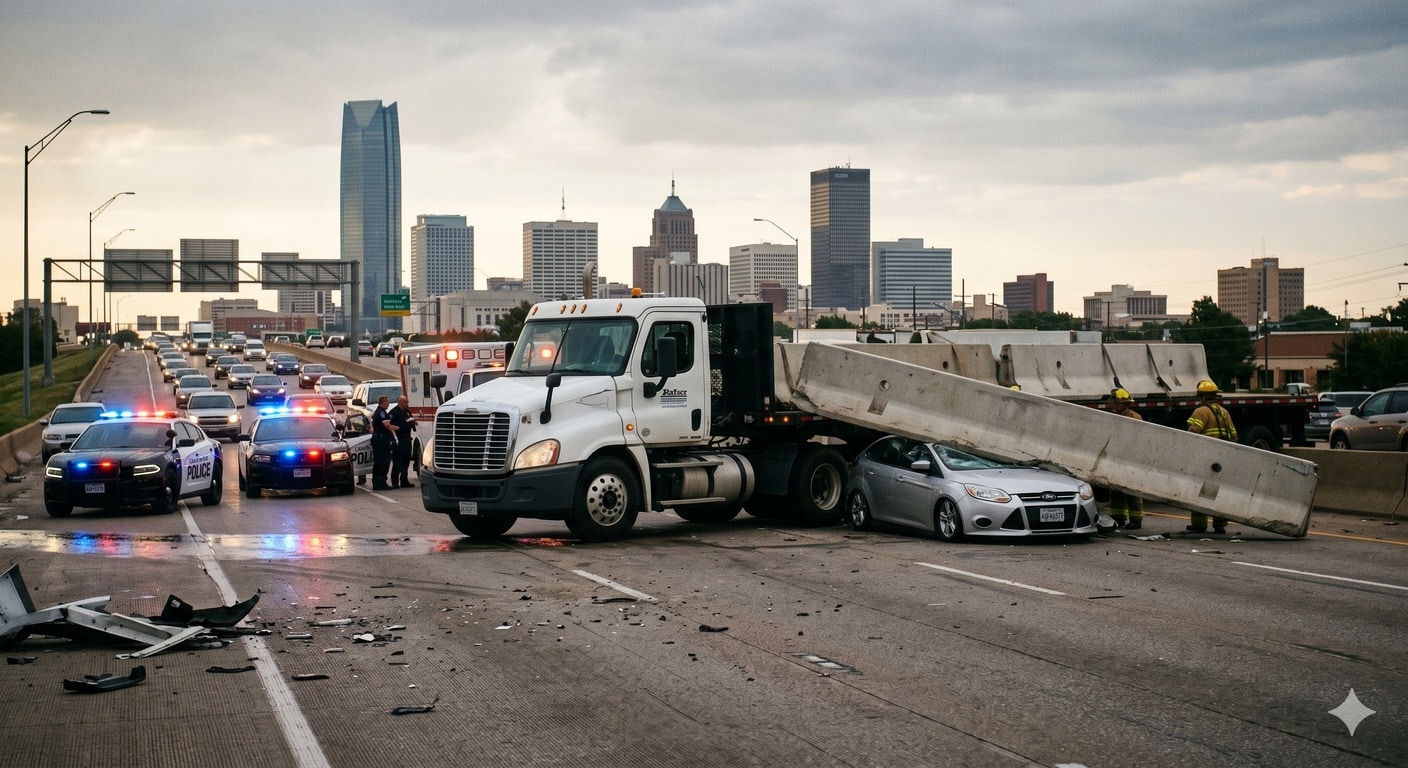
April 8, 2026. Late morning on Interstate 35 near Hefner Road, right in the heart of Oklahoma City. A commercial truck shed part of its load onto the highway. A young mom named Mercedes Bayne, 36, was driving south with her 4-year-old daughter in the back seat. She swerved — maybe to miss the debris, maybe to miss the cars braking ahead of her. Her SUV crossed the cable barrier and slammed into the northbound lanes, where Oklahoma Highway Patrol Trooper Vernon Brake was on duty.
All three of them died right there on the pavement. A trooper just months from his 20-year anniversary with OHP. A mother. A preschooler.
And the truck that caused it? It rolled on. The driver later came forward and is cooperating with investigators, but here’s the part that should stop every Oklahoma City driver cold: the trucker never actually hit anyone. The cargo did the killing.
This wasn’t a freak accident. It’s part of a pattern we’ve been watching grow on metro highways, and if you drive I-35, I-40, or I-44 with any regularity, you need to know what’s going on.
Why Oklahoma City is Seeing More “Lost Load” Crashes
The geography here is unforgiving. OKC sits at the junction of three of the busiest freight arteries in the country. Trucks pour through the metro 24/7 carrying gravel, steel pipe, oilfield equipment, lumber, consumer goods, hazmat — basically anything that has to get from point A to point B in middle America.
Most of those loads are tied down properly. But “most” isn’t “all,” and when the straps fail or the loaders cut a corner, what was sitting on a flatbed at 70 mph becomes a missile.
Just a few weeks before the I-35 tragedy, OKC firefighters had to handle two big-rig incidents on the same day. A semi hauling rock collided with a train near Newcastle Road and S. Rockwell Avenue. Then a tanker truck rolled over near SW 119th Street and Williamson Farm Boulevard. The driver, according to the responding fire department, drifted slightly off a narrow road and the whole rig went over.
Different scenarios, same root cause: when commercial vehicles are pushed hard through a metro that wasn’t designed for this kind of freight volume, things go wrong. And when they go wrong, regular drivers pay the price.
If you’ve been hurt by one of these wrecks, the Oklahoma truck accident attorneys at McKay Law have probably seen something just like it.
How Cargo Actually Falls Off a Truck (It’s Not What You Think)
Most folks assume a load just “falls off” because of bad luck or a sharp turn. The reality is messier. Here’s what actually causes it:
Lazy loading. Steel coils, pipe, lumber, and machinery have to be tied down using a specific number of chains, straps, and binders based on weight and length. Federal law spells it out. But shippers under deadline pressure rush. Drivers don’t always check the work. Stuff that was “fine when we left the yard” becomes a problem 200 miles later.
Trucks loaded over the limit. Overloading or stacking too high makes a rig top-heavy, which is why you see so many rollovers on the curving interchanges between I-35, I-40, and the Kilpatrick. Our overloaded trucks page digs into this in more detail.
Tanker problems. Liquid cargo sloshes if the baffles inside the tank are bad or the truck isn’t maintained right. One sharp lane change and the whole thing tips. We handle these specifically — see our tanker truck accident page.
Worn-out gear. Frayed straps, broken tarps, missing tailgate pins, rusted tie-down points. None of this is exotic. It’s basic maintenance, and when it gets skipped, debris hits the road. This often overlaps with un-maintained vehicle claims.
The chain reaction. This is the brutal part. The truck doesn’t have to touch you to kill you. Debris hits the road, drivers panic, somebody brakes hard, somebody swerves, and suddenly there’s a crash — or, like on April 8, a median crossover that ends three lives in a heartbeat.
Who’s Actually on the Hook?
Here’s where these cases get complicated, and truly, where having the right lawyer matters more than anything else.
A regular car wreck is usually one driver versus another. A truck wreck — especially a lost-load wreck — can pull in five or six different defendants:
- The driver, for not inspecting the load or not stopping when the cargo started shifting
- The trucking company (motor carrier), for bad training, unrealistic delivery deadlines, or pressuring the driver to skip safety steps
- The shipper or whoever loaded the cargo, if the load was wrong before the truck ever rolled out
- The owner of the truck or trailer, if the equipment itself was defective or neglected
- A maintenance contractor, if straps or trailer components were serviced incorrectly
- The manufacturer, if a strap, latch, or tie-down failed because of how it was designed
A defense attorney commenting on the April 8 OKC crash made an important point: under Oklahoma law, failing to secure a load is a misdemeanor. And in our state, if a misdemeanor causes someone’s death, that can support a manslaughter charge against the driver. On the civil side, the trucking company and its insurance carrier can be held responsible for the entire cost of what happened — even though their truck never touched the victim’s vehicle.
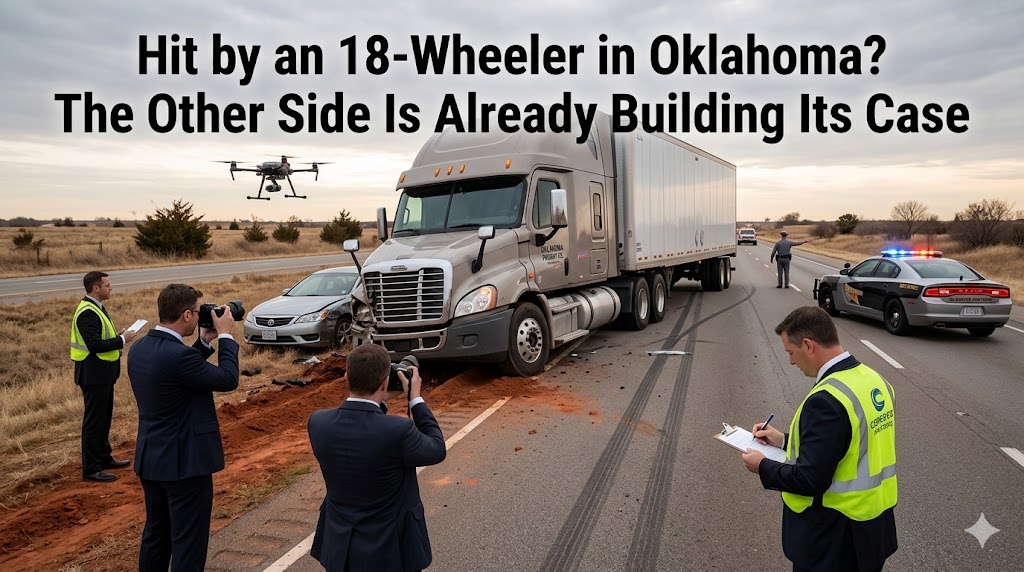
That’s why filing a wrongful death claim against a trucking company is a race against the clock. Black-box data gets overwritten. Dash cam footage gets deleted. Trucking companies have rapid-response investigators who show up at the scene within hours of a crash, and they’re not there to help the victim’s family.
The Federal Rules Trucking Companies Hope You Don’t Know About
Anyone hauling commercial cargo through Oklahoma has to follow the Federal Motor Carrier Safety Regulations — specifically Part 393, Subpart I. It lays out, in detail, exactly how cargo must be tied down, blocked, and braced.
Some of the violations we see most often:
- Not enough tie-downs for the weight and length of the load
- Damaged, frayed, or expired straps and chains
- Skipping the required cargo inspection in the first 50 miles of a trip
- Failing to re-check the load after every duty change or every three hours of driving
- Ignoring working load limits
Proving one of these violations changes a case. It doesn’t just establish negligence — it can open the door to punitive damages, which exist specifically to punish the trucking company for putting profit ahead of basic safety.
Why Our Interstates Are So Brutal
OKC’s highway system was built for another era. The I-35/I-40 Crosstown, the I-235 split downtown, the Kilpatrick Turnpike interchanges, where I-44 meets I-35 in the north metro — all of these funnel huge trucks through tight, fast merges where there’s almost no margin for a mistake.
Add in Oklahoma weather (sudden thunderstorms, ice, fog, the crosswinds that hit the open country south of the metro), and you have exactly the conditions that produced 2026’s worst truck-related headlines.
If you commute I-35 between Moore and Edmond, take I-40 through downtown every day, or work near the industrial corridors in southeast OKC, this risk isn’t abstract. It’s part of your morning routine.
What to Do If a Truck Hits You — or a Truck’s Cargo Does
The first hour after a crash matters more than you’d think. Here’s what we tell people:
- Call 911 right away. Get OHP or OKCPD on scene, and let the EMTs check you out — even if you “feel okay.” Adrenaline lies. So do soft-tissue injuries.
- Take pictures of everything. The debris, the truck (DOT number, plate, anything you can grab), the road, your injuries, your vehicle. If the truck rolled on, get whatever partial info you can.
- Find witnesses. In a debris case, the trucker may not even know they lost something. Other drivers and dash cam footage are often the only way to identify which carrier is responsible.
- Don’t give a recorded statement to any insurance adjuster. Not yours. Definitely not the trucking company’s. They appear friendly, but their job is to get you to say something that hurts your claim.
- Get the official crash report. You can request it from Oklahoma Highway Patrol or the responding agency.
- Call a truck accident lawyer fast. Trucking companies move within hours. You need someone protecting your evidence on the same timeline.
Helpful Resources for OKC Truck Accident Victims
If you or somebody you love was hurt by a falling load, debris, or a commercial truck on a metro roadway, these resources can help you understand what happened and what comes next:
- Oklahoma Highway Safety Office — Current Crash Data. The state’s official Crash Facts books and interactive crash dashboard.
- FMCSA Crash & Safety Statistics. Federal data on large truck and bus crashes broken down by state, configuration, and cause.
- NHTSA. National fatality and injury data, vehicle recalls, and safety research.
- FMCSA Cargo Securement Rules. The actual federal rules truckers are supposed to follow.
- OKC Response & Accident Tracker. Real-time map of active emergency calls in the city.
- Insurance Institute for Highway Safety — Large Trucks. Independent research on commercial truck safety.
Why People Call McKay Law
Truck cases aren’t car cases. They shouldn’t be handled by a lawyer who treats them the same. Here’s what we bring to the table:
- Over $500 million recovered for our clients, including a recent $6 million wrongful death settlement in a truck case
- A truck-focused team that has handled more of these cases than any other firm in Oklahoma
- Membership in the Academy of Truck Accident Attorneys (ATAA) — a small, invitation-based group of attorneys nationwide who do nothing but commercial trucking litigation
- No fee unless we win. Period.
Whatever kind of truck wrecked your life — an 18-wheeler, a semi, a box truck, a tanker, a delivery vehicle, or any other commercial vehicle — we know how to go after the carrier, the shipper, and the insurer.
Don’t Wait
What happened on I-35 on April 8 should haunt every trucking company in this state. One sloppy load. Three coffins. That’s the trade-off when corners get cut.
If you’ve lost somebody or you’re sitting in a hospital bed because a trucker, a shipper, or a motor carrier didn’t do their job, you deserve more than sympathy. You deserve answers, accountability, and every dollar the law allows.
Don’t settle for the first number an adjuster throws at you. Don’t sign anything before talking to a real truck accident lawyer.
📞 866-679-9651 — answered 24/7 💻 Request a free case review online
We don’t get paid unless you do.
This article is general information, not legal advice. Every truck accident case turns on its own facts, and reading this doesn’t make us your lawyers. If you want specific advice about your situation, give us a call.