“I Never Even Saw Him”
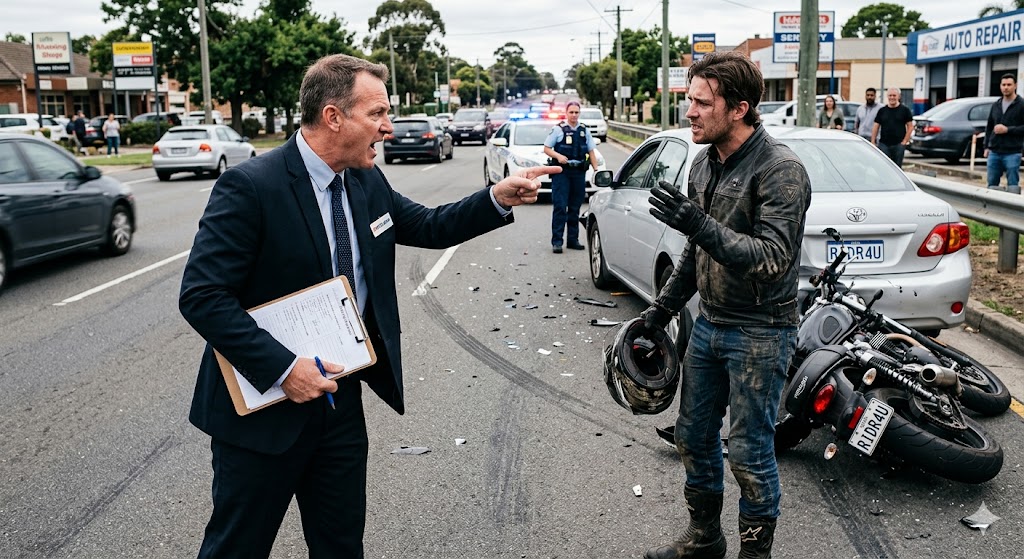
It’s the kind of afternoon you ride for. Clear sky over Route 66 east of Tulsa, the engine settled into a easy rhythm, the road yours. Then a sedan waiting at the cross street decides the gap is big enough. It turns left directly across your lane, and the few feet between you collapses into nothing. There’s no time to do anything but react, and then you’re on the pavement, and the driver is climbing out saying the four words that will shape everything that follows: I never even saw him.
That sentence is an admission. The driver violated your right of way and failed to yield. But here’s what every rider learns the hard way: by the time the police clear the scene, a quiet story is already forming — and it isn’t about the driver who didn’t look. It’s about the motorcycle. Must have been flying. Probably weaving. You know how those bikers are.
You did nothing wrong. The fight ahead is against the assumption that you did.
The Adversary: Biker Bias
The opponent after an Oklahoma motorcycle crash isn’t really the driver who turned left. It’s a prejudice that arrives before the facts do — the reflexive belief that motorcyclists are reckless, that a rider who got hurt was probably “asking for it.”
That bias is the insurance adjuster’s most valuable asset, because they don’t have to prove you were careless. They just have to nudge a story everyone is already inclined to believe. So they reach for a familiar set of tools: they suggest you were speeding with no evidence, they float that you were lane-splitting (illegal in Oklahoma and easy to allege), and — if you weren’t wearing a helmet — they argue your injuries are partly your own fault. Every one of those moves has the same goal: shift a percentage of blame onto you, because under Oklahoma law each point of fault they pin on you is a point they don’t have to pay.
The most dangerous part is how natural it all sounds. Left unchallenged, biker bias quietly turns a clear-liability crash into a “shared fault” discount — or a denial. Beating it is the entire job.
What This Article Promises
This is the playbook McKay Law uses to dismantle biker bias with facts — the same approach behind more than $100 million recovered for injured clients, now focused on Oklahoma’s riders. By the end, you’ll understand what actually causes most motorcycle crashes, how Oklahoma’s fault rules get weaponized against you, the truth about the “helmet defense,” what a serious rider-injury claim is really worth, and the deadlines that quietly end cases. No theory. Just the mechanics.
Key Takeaways
- The driver usually causes the crash. Left-turn collisions — a car turning across a rider’s path — are the single most common type, and “I didn’t see the motorcycle” is an admission of failure to yield, not your fault.
- Bias is the real obstacle. Adjusters and juries often assume riders are reckless; insurers exploit that to shift blame under Oklahoma’s comparative-negligence rule.
- Oklahoma doesn’t require adult helmets. State law mandates helmets only for riders under 18, so an adult who chooses not to wear one is following the law.
- The “helmet defense” confuses two things. Helmet use relates to injury severity, not who caused the crash — and insurers blur that line on purpose.
- Rider injuries are severe, and so are the claims. Federal data shows motorcyclists are dramatically more likely to be killed or seriously hurt, and Oklahoma places no cap on pain-and-suffering damages.
- You have two years — but act sooner. Scene evidence and the driver’s early admissions don’t last.
The Direct Answer, Then the Evidence
Will the fact that you were on a motorcycle hurt your claim? It can — not because Oklahoma law disfavors riders, but because bias does, and insurers are skilled at exploiting it. Here is the evidence chain that takes that advantage away.
Step 1: Establish what actually happened
Most motorcycle crashes are caused by the other driver, not the rider. The classic pattern is the left-turn collision: a motorist turns left across the path of an oncoming motorcycle, having “looked but not seen” the smaller, narrower profile of a bike. Lane-change crashes by drivers who don’t check mirrors, and road-hazard wipeouts from potholes or debris, round out the common causes. Pinning down the real sequence — through the police report, scene geometry, and witness accounts — is step one, because the facts are almost always friendlier to the rider than the assumptions are.
Step 2: Understand how the fault rule gets weaponized
Oklahoma follows modified comparative negligence under Okla. Stat. tit. 23, § 13: your recovery is reduced by your share of fault, and if your share exceeds the other party’s — more than 50% — you recover nothing. That rule is fair on paper. The problem is that bias lets an insurer manufacture fault out of thin air: a baseless speeding claim, a lane-splitting accusation, a suggestion you “came out of nowhere.” This is also why you should never give the at-fault insurer a recorded statement before talking to a lawyer — a single offhand phrase can be converted into a fault percentage and a smaller check.
Step 3: Know the truth about the “helmet defense”
Oklahoma’s helmet law, Okla. Stat. tit. 47, § 12-609, requires a DOT-compliant helmet only for operators and passengers under 18. Adults 18 and older may legally choose not to wear one. (Eye protection is separately required unless the bike has an adequate windshield.) Insurers nonetheless try to argue that an unhelmeted adult rider is partly to blame for their own head injuries. The critical distinction a good lawyer drives home is this: helmet use goes to injury severity, not to who caused the crash. Whether you wore a helmet has nothing to do with whether the driver failed to yield — and Oklahoma courts are often skeptical of the “helmet defense” for exactly that reason. The same logic answers the lane-splitting accusation: it’s illegal in Oklahoma, but alleging it and proving it are very different things.
Step 4: Know what the claim is really worth
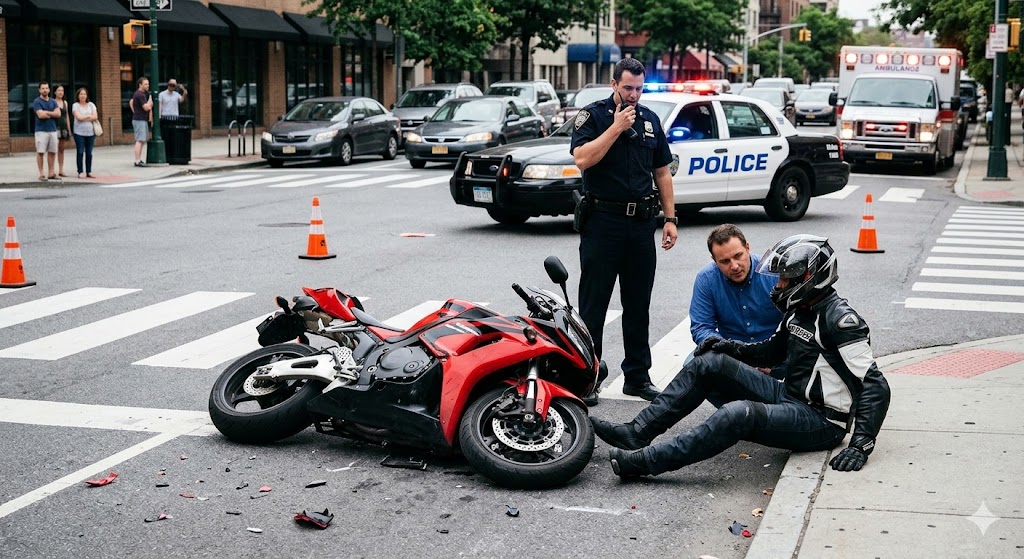
When a motorcycle and a car collide, the rider absorbs the impact with no cage around them — which is why injuries are so often catastrophic. According to the National Highway Traffic Safety Administration, per mile traveled motorcyclists are nearly 27 times more likely than car occupants to die in a crash and almost 5 times more likely to be injured, and more than 6,000 riders are killed nationwide each year. That translates into traumatic brain injuries, spinal damage, multiple fractures, severe road rash, amputations, and fatal crashes. A serious claim therefore reaches well beyond the bike: past and future medical care, lost wages and earning capacity, and non-economic damages — pain, suffering, disfigurement, loss of enjoyment of life — which Oklahoma does not cap by statute. The bias exists precisely because these claims are large; the insurer’s whole strategy is to shrink them.
Step 5: Preserve the evidence — fast
Two kinds of proof win a motorcycle case. The first is what happened: the crash report, scene and vehicle photographs, skid and gouge marks, debris fields, nearby traffic-camera footage (often overwritten within weeks), witness names, and — crucially — the driver’s own early statements, including any version of “I didn’t see him.” The second is the injury: prompt, consistent medical treatment, because gaps in care get argued as proof you weren’t badly hurt. Lock the first category down before memories harden and the scene is gone, and protect the second by getting evaluated immediately even if adrenaline has you feeling “fine.”
Step 6: Beat the clock
Oklahoma’s statute of limitations for a motorcycle-injury lawsuit is generally two years from the date of the crash (Okla. Stat. tit. 12, § 95); a wrongful-death claim is likewise generally two years, measured from the date of death. And because Oklahoma has a high share of uninsured drivers, your own uninsured/underinsured motorist (UM/UIM) coverage is often the difference between a real recovery and an empty judgment — another reason to get a lawyer reviewing every available policy early.
On the Ground in Oklahoma City and Tulsa
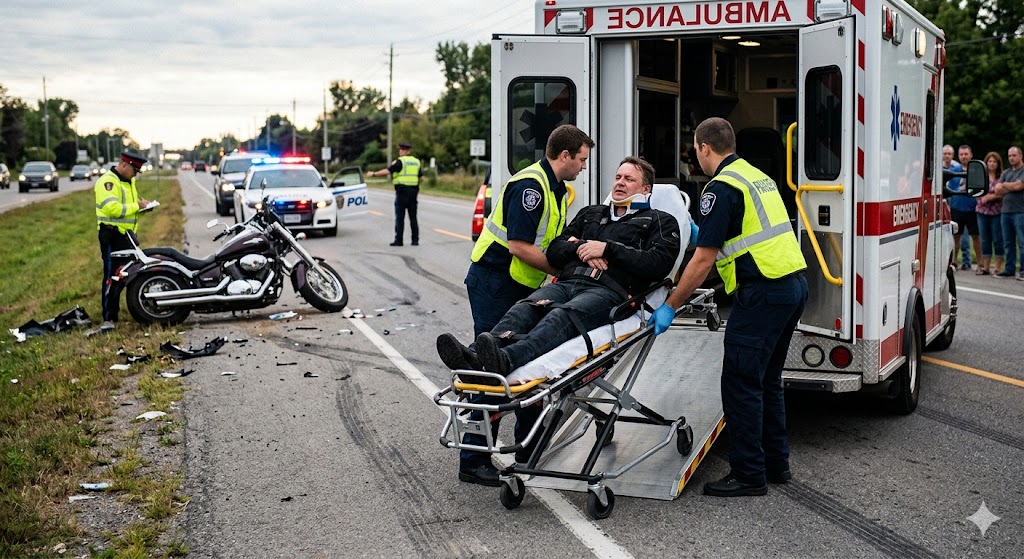
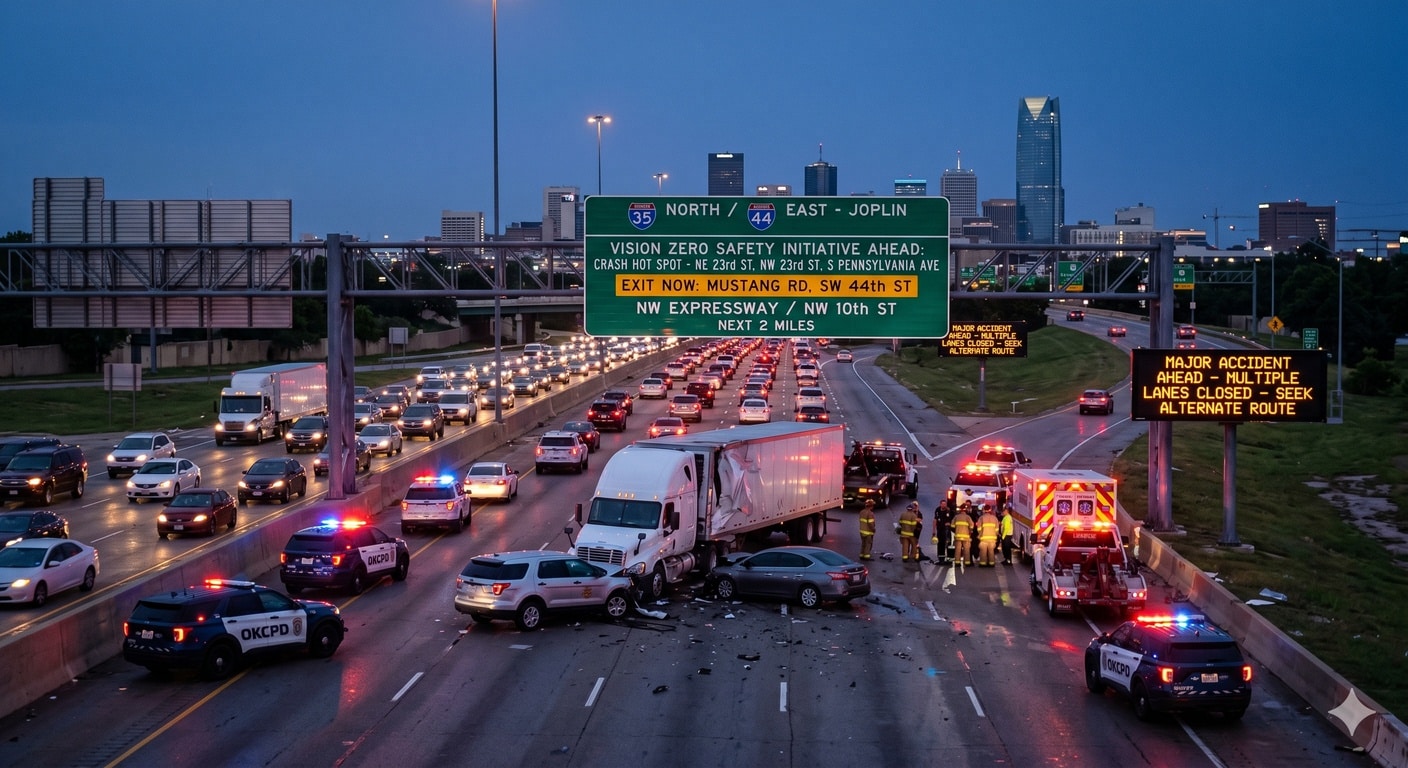
Oklahoma is good riding country, which means it’s also where these crashes happen. The metros do the most damage: Oklahoma City sits at the convergence of I-35, I-40, and I-44, and the Oklahoma Department of Transportation consistently records the highest crash density there — but the deadliest motorcycle scenario isn’t the open interstate. It’s the city intersection, where a left-turning driver and an oncoming rider meet. Tulsa’s arterials produce the same pattern, and rural two-lanes across the state add their own hazards: gravel, blind curves, and drivers who simply aren’t looking for a bike.
After a serious wreck, riders are taken to the region’s trauma centers — OU Health and SSM Health St. Anthony in Oklahoma City, Saint Francis and Hillcrest in Tulsa — while the claim moves through the at-fault driver’s insurer and, if it doesn’t settle fairly, into the district court where the crash happened. Knowing the local courts and how to confront jury bias against riders in those courtrooms is its own skill. McKay Law keeps offices in both metros to handle these cases close to home:
- Oklahoma City: 201 Robert S. Kerr Ave., Suite 700, Oklahoma City, OK 73102 — (405) 222-0000
- Tulsa: 5401 S. Harvard Ave., Suite 103, Tulsa, OK 74135 — (918) 236-0000
- Statewide, 24/7: Request a free case evaluation or call (866) 679-9651
Frequently Asked Questions
I wasn’t wearing a helmet. Is my case over? No. Oklahoma only requires helmets for riders under 18, so as an adult you broke no law. Insurers may still try to argue helmet non-use increased your head injuries, but that goes to injury severity, not to who caused the crash — and it’s an argument an experienced lawyer can challenge.
The driver’s insurer says I was speeding or lane-splitting. Now what? These are classic bias tactics, often raised with little or no evidence. Lane-splitting is illegal in Oklahoma, but alleging it isn’t proving it. Don’t accept a fault percentage you don’t agree with, and don’t give a recorded statement — the facts and the physical evidence usually tell a different story.
Why is my claim worth more than the property damage on the bike? Because riders absorb the full force of a crash. Serious injuries — brain trauma, spinal damage, road rash requiring grafts, amputations — drive medical bills, lost income, and pain-and-suffering damages far beyond the cost of the motorcycle, and Oklahoma sets no cap on those non-economic damages.
What kinds of cases does McKay Law handle? The full range of road-injury cases, from motorcycle and bicycle crashes to car and commercial-vehicle collisions. You can review the firm’s results and its broader Oklahoma injury practice areas to see the scope.
What does it cost to find out if I have a case? Nothing up front. McKay Law handles motorcycle cases on a contingency basis: the firm advances the costs of investigation and litigation, and you owe an attorney’s fee only if there’s a recovery.
This article is general legal information for Oklahoma riders and is not legal advice. Every case turns on its own facts, and laws change. No outcome is guaranteed, and prior results do not predict future results. For advice about your specific situation, speak with a licensed Oklahoma attorney.
About the Author
Lindsey McKay — Managing Partner, McKay Law (Oklahoma) · Oklahoma Bar No. 36895
Lindsey McKay leads McKay Law’s Oklahoma personal injury practice from the firm’s Oklahoma City and Tulsa offices. McKay Law built its reputation representing seriously injured accident and wrongful-death clients and has recovered more than $100 million in verdicts and settlements over the course of its history. The firm brought that approach to Oklahoma — maximum medical treatment before settlement, aggressive investigation of fault, and a guaranteed weekly client update — to represent motorcyclists and other crash victims across the state. Lindsey McKay is licensed to practice law in Oklahoma (Bar No. 36895) and is admitted before the Oklahoma state courts.
Injured in a motorcycle crash in Oklahoma? Contact McKay Law for a free, no-obligation case review — Oklahoma City (405) 222-0000 · Tulsa (918) 236-0000 · 24/7 statewide (866) 679-9651.